It is simply the cost of 2 to 4 minutes to get us registered, and that allows for 3 years of movement to cross borders.
Europe has just launched one of its biggest border control changes in decades. On October 12th, the European Union began rolling out its new Entry-Exit System, known as EES. This digital border management system is transforming how hundreds of millions of travelers enter and leave the Schengen Area.
But what exactly is this system? Why is it being introduced? And what does it mean for travelers worldwide?
The Entry-Exit System is an automated digital platform that replaces traditional passport stamping with biometric registration. This weekend, on Sunday the 12th of October, marks the beginning of a six-month process called EES — the installation of the entry and exit system for travelers going into the Schengen zone within the EU.
What’s important about this is that it’s a digital travel system designed to make travel much smoother for entry and exit — but also more secure by keeping everyone’s information safe, ensuring there’s no criminal activity or breaches of security when entering the EU.
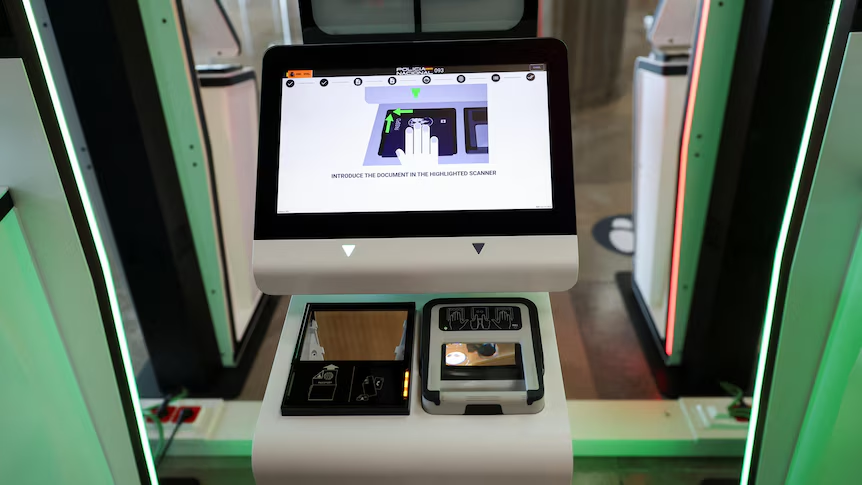
When non-EU travelers enter any of the 29 participating countries, they’ll have their fingerprints scanned and facial images captured at immigration booths or self-service kiosks. The system records passport details, entry and exit dates, and even refusals of entry. This data is stored for 3 years and automatically renews with each border crossing.
The EES applies to all non-EU nationals making short stays of up to 90 days within any 180-day period. This includes travelers from visa-exempt countries like the United States, United Kingdom, Canada, and Australia, as well as those who require short-stay visas. EU citizens and those holding long-term residence permits are exempt from the system. Children under 12 must register but only need to provide a photograph, not fingerprints.
Kiosks are being installed at entry ports — land, sea, railway stations, and airports. What’s critical is that a traveler will approach the kiosk and enter their biometric dаta: a facial scan and fingerprints. However, for travelers under the age of 12, no fingerprints will be taken.
So why is the EU implementing this system? Security is the primary driver. The EES aims to prevent irregular migration, detect identity fraud, and help authorities track overstayers more efficiently. Traditional passport stamps can fade, be forged, or misplaced. The digital system eliminates these vulnerabilities while supporting broader efforts to combat terrorism and organized crime.
It also enables wider use of automated border controls, which should eventually make crossings faster for frequent travelers.
The rollout is happening gradually over 6 months, with full implementation expected by April 10th, 2026. During this transition period, passport stamping will continue alongside biometric registration.
Countries like Estonia and Luxembourg launched the system fully on day one, while larger nations are implementing it in phases — starting with major airports before expanding to land and sea borders.
The rollout will take approximately 6 months because, from this weekend, only about 10% of the kiosks are being installed. It’s an enormous investment in infrastructure and training. So, travelers will still encounter passport stamping for now, but slowly, as the process develops, full implementation will happen.
Hopefully, by April 2026, travelers will no longer need passport stamps and can go straight through scanners to their destinations.
At 30 days into the rollout, countries must be registering at least 10% of travelers. For travelers, the first registration will take a few extra minutes, but subsequent trips will be faster, as automated gates will verify stored biometric data.
Some countries have introduced a “Travel to Europe” app, allowing passengers to pre-register their information up to 72 hours before arrival. Sweden is the first country to adopt this feature, with others expected to follow.
These are the 29 countries in the Schengen Area where this EES system will be applicable. The rollout will take approximately 6 months because, from this weekend, only about 10% of the kiosks are being put in place. It’s an enormous investment in infrastructure and training. So, travelers will still encounter passport stamping for now, but slowly, as the process develops, full implementation will happen. Hopefully, by April 2026, all of us will simply be able to avoid the little stamps on our passports and go straight through scanners and into our destinations.
Looking ahead, the EES is just the first step. The European Travel Information and Authorization System (ETIAS) is scheduled to launch in late 2026. This visa waiver system — similar to the U.S. ESTA — will require travelers from visa-exempt countries to obtain pre-travel authorization online for a small fee.
Together, these systems represent Europe’s comprehensive approach to modernizing border security while maintaining the ease of travel that has made the continent one of the world’s most visited destinations.
There are always going to be concerns about data privacy, but interestingly, those concerns are not necessary to worry about because all of this is being implemented to keep travelers safer, not the other way around.
Ultimately, traditional passport systems have risks: criminal intent, identity theft, and even network failures at airports. By adopting EES, the EU is minimizing and mitigating these risks.
Related
